
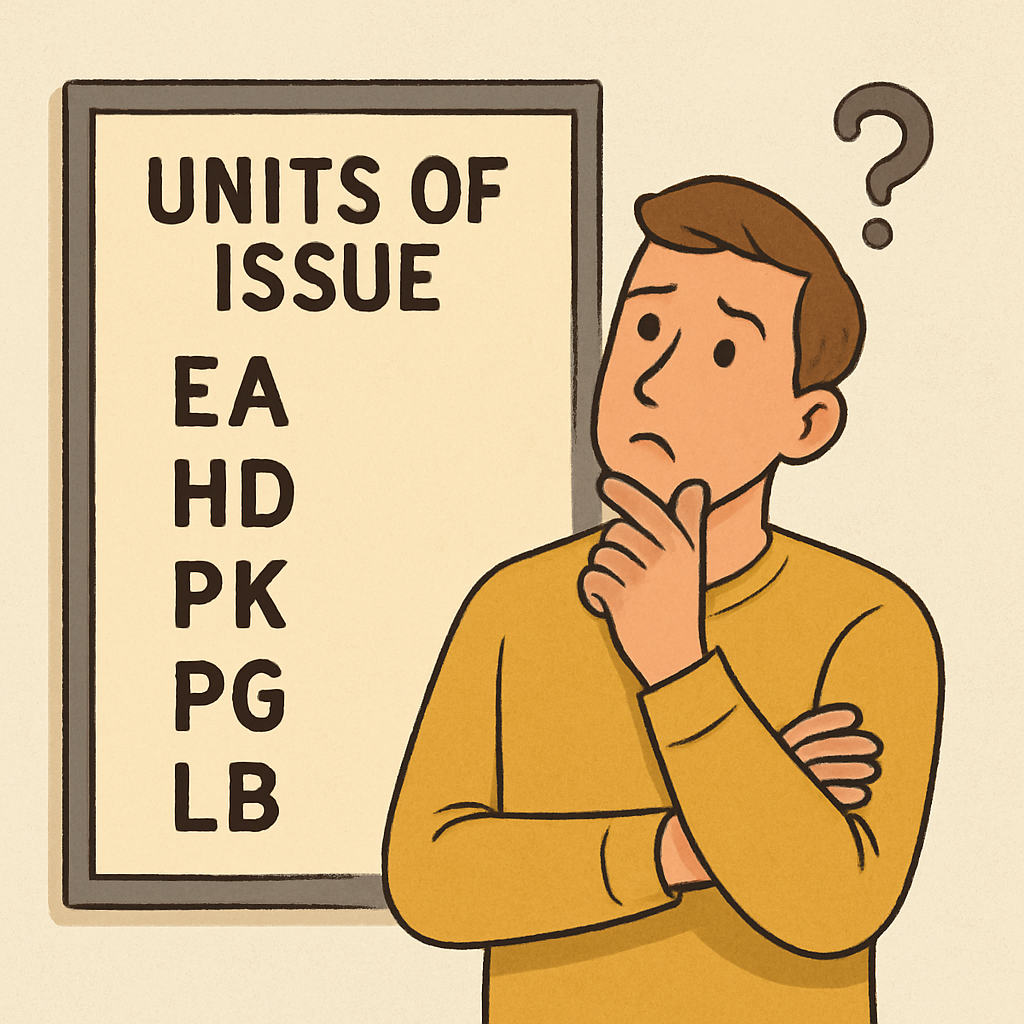
Why the unit of issue matters
One of the most overlooked details in government contracting is the unit of issue. Every contract line item number (CLIN) specifies not only what you’re supplying, but how it’s measured.
Most of the time, you’ll see EA (each), but contracts often use other unit codes such as:
- HD – hundred
- PK – pack
- PG – package
- LB – pound
- …and many others.
If you ignore the unit of issue or assume it’s always “each,” you risk quoting the wrong quantity—and losing the contract.
How it affects vendor quotes
When you request quotes from your vendors, you need to convert the government’s unit of issue into the unit your vendor uses.
For example:
- The contract line item calls for 5 HD
- “HD” means hundred
- That equals 500 units
When you ask your vendor for pricing, you must request a quote for 500 units, not just “5.”
Backtracking the math for bidding
Once your vendor gives you a price, you’ll need to convert it back into the correct unit of issue for your bid.
Continuing the example:
- Vendor quote: $1.20 per unit
- 500 units x $1.20 = $600
- 5 HD = $600 → Your bid should reflect the cost per hundred as specified in the contract.
This way,theyour pricing aligns exactly with the government’s requirement.
Common unit of issue codes
Here are a few you’ll commonly encounter in DLA solicitations:
- EA – Each
- HD – Hundred
- PK – Pack
- PG – Package
- LB – Pound
- DZ – Dozen
- CN – Can
- RO – Roll
Knowing these codes—and having a quick reference sheet—saves you from costly mistakes.
Key takeaway
Every time you bid on ,a government contract, check the unit of issue for each line item. Convert it properly when requesting vendor quotes, and backtrack the math when preparing your bid.
It may seem like a small detail, but it’s one of the easiest ways to prevent errors that could cost you an award.
Want to avoid mistakes and speed up your bidding process?
GovScraper organizes RFQs, flags unit of issue codes, and helps you prepare clean vendor requests so you can focus on winning.
Book a demo today and see how GovScraper keeps you one step ahead.


Member discussion: