
Quick take
- RQ001 means the buyer wants higher-level quality controls on this item.
- It applies to manufacturers and non-manufacturers.
- You often need a documented quality system aligned with recognized standards.
- A third-party certificate isn’t always required! But it is good to have.
What RQ001 actually means (plain English)
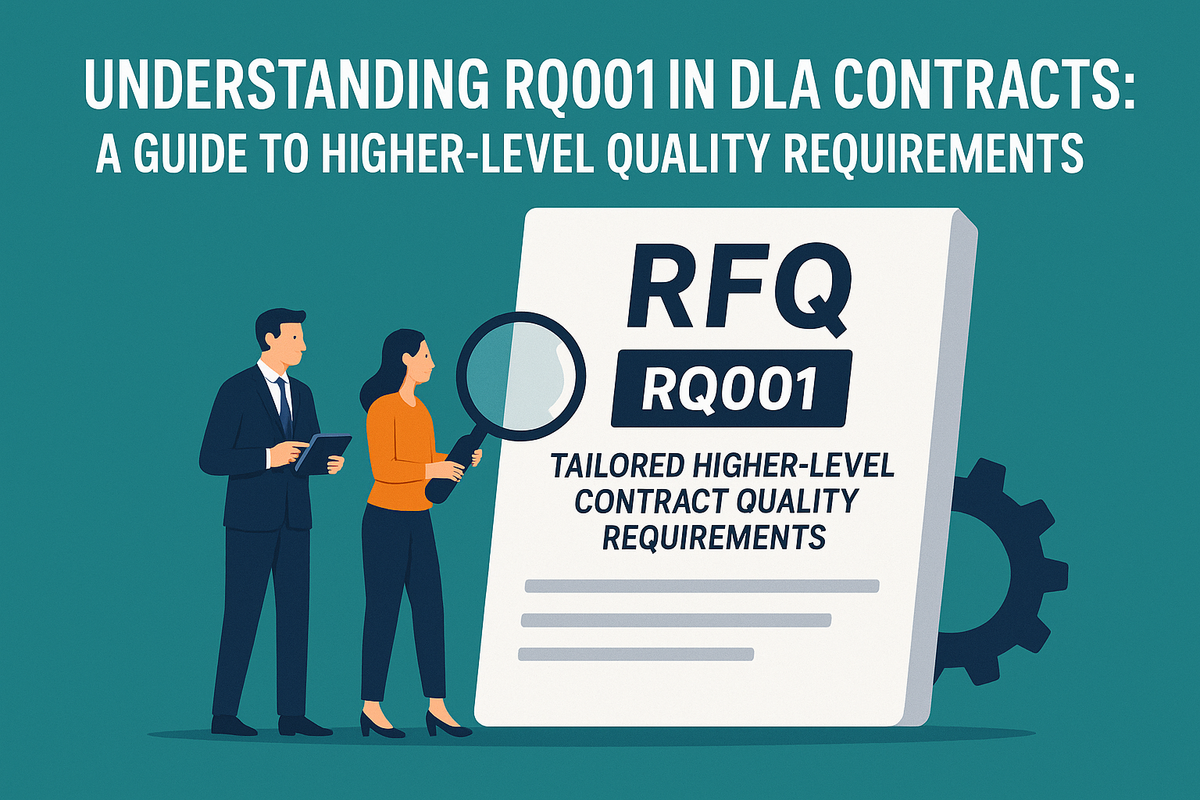
RQ001: Higher Level Contract Quality Requirements is the DLA’s way of saying: “This item matters. We need extra confidence in how it’s built or sourced.” You’ll usually see it on parts with critical applications, a history of failures, or tight tolerances. When RQ001 appears, expect to show that your processes aren’t on a whim, but you have a real, documented Quality Management System (QMS) and you follow it.
Who does RQ001 apply?
If you’re a manufacturer:
You’ll be expected to document and follow a higher-level QMS (commonly aligned to ISO/AS families or equivalent). The point isn’t just to hold the cert, but it is the processes you use: controlled documents, trained people, calibrated tools, traceable records, and consistent inspections.
If you’re a non-manufacturer (distributor/reseller)
Two buckets of evidence matter:
- Traceability back to a compliant manufacturing source (part/NSN, CAGE, lot/date codes where available, and supply-chain intermediaries).
- Your own QA practices: receiving inspection, records retention, nonconformance handling, and proof that you can segregate suspect stock.
Do you need a certificate to bid?
Not necessarily. RQ001 usually requires conformance to a higher-level quality system. Sometimes a third-party certificate (e.g., ISO 9001 or AS9100) is explicitly required; sometimes it isn’t. If the RFQ doesn’t mandate certification, you can still bid as long as you can prove your QMS meets the stated controls.
Bottom line: Don’t skip a bid just because you don’t hold a certificate yet. Read the RFQ language and respond accordingly.
How to spot RQ001 quickly in an RFQ
- Scan the clauses section for RQ001 (you’ll often see it alongside the other “RQ” clauses).
- Look for a Higher-Level Contract Quality clause or notes telling you which standard(s) apply.
- Determine your role (manufacturer vs. non-manufacturer) and match the documentation to that role.
A practical, bid-ready QMS checklist (use this when RQ001 appears)
Core controls
- Quality manual & procedures that match the higher-level requirement in the RFQ.
- Document control (revisions, approvals, distribution).
- Training & competence records for personnel performing quality-critical work.
- Calibration for measurement/test equipment (with recall dates and certificates).
- Receiving & in-process inspections with acceptance criteria; keep photo/measurement evidence where helpful.
- Nonconformance & corrective action (log issues, contain them, fix root causes).
- Records retention policy (what you keep, where, how long).
Non-manufacturer add-ons
- Objective evidence that your source meets the higher-level requirement (certificates if required, or equivalent proof of conformance).
- Traceability map: manufacturer → intermediaries → you → government, including lot/date/serial when available.
- Stock control: ability to quarantine/segregate suspect or nonconforming items.
AS9100 vs. ISO 9001 vs. AS9003 - quick guide
- AS9003: Lean inspection-focused system - popular with aerospace distributors and short-run manufacturers.
- ISO 9001: Broad, widely recognized; can be tailored to meet aerospace-style controls for many RQ001 situations.
- AS9100: Aerospace QMS with more rigorous requirements; pursue when your pipeline or buyers explicitly expect it.
Practical path: Implement the controls you need to win now; upgrade to formal certification when awards and customer expectations justify it.
FAQ
1) Does RQ001 always require AS9100?
No. It requires higher-level quality controls. Only submit a certificate if the RFQ specifically demands one; otherwise, show conformance.
2) I’m a distributor - what’s the minimum I need?
Solid receiving inspection, records retention, and traceability back to a compliant manufacturer. Keep objective evidence on file and ready to share.
3) Where will I see RQ001 in the RFQ?
In the clauses or notes. It’s often grouped with other requirement codes. Read the language that explains which controls or standards apply.
4) Why do some parts have RQ001 and others don’t?
It’s typically added for critical, complex, or higher-risk items where the buyer wants extra assurance.
5) If I don’t have a certificate, can I still win?
Yes! If the RFQ doesn’t require a certificate. Show that your documented QMS meets the controls and that you maintain traceability and inspection records.
Ready to move faster on RQ001 bids?
GovScraper helps you surface the right DLA RFQs every day so you can spend time on supplier coordination and quality evidence—not hunting for opportunities. Want to see how we filter RFQs and flag quality requirements right inside your workflow? Book a live demo, and we’ll walk through a current RFQ together.


Member discussion: